
All India EVAll India EVAll India EV
Notification
Font ResizerAa
  • Home
  • EV News
  • EV Launch
  • Market Insights
  • Investments & Funding
  • Guest Articles
  • EV Engineering
  • Contact
Reading: Hyundai Plans 5 Made-in-India EVs by 2030
Share
All India EVAll India EV
Font ResizerAa
  • Home
  • EV News
  • EV Launch
  • Market Insights
  • Guest Articles
  • EV Engineering
  • Contact
Search
Follow US

Hyundai Plans 5 Made-in-India EVs by 2030

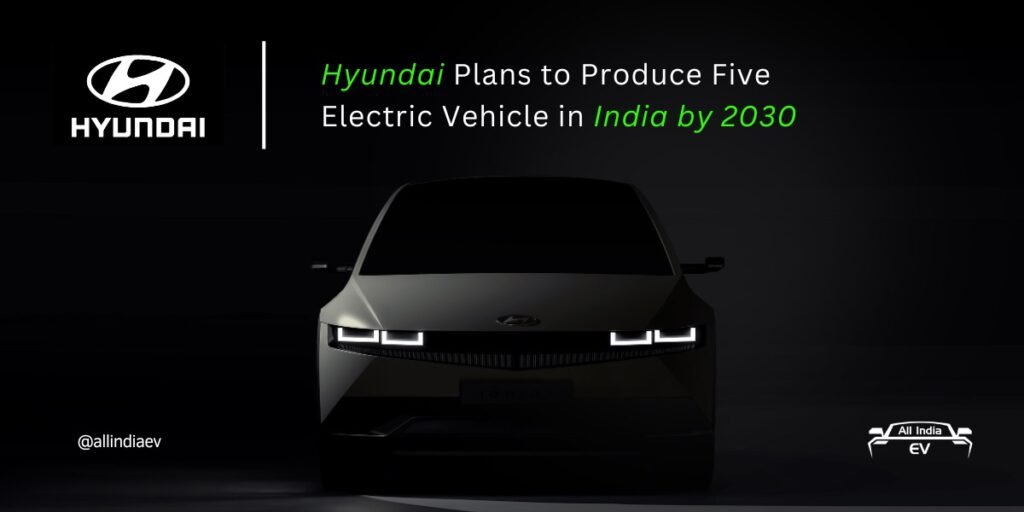
Hyundai has revealed its ambitious aim to introduce five locally-built electric vehicle (EV) models into the Indian market by 2030. The CRETA EV will undoubtedly be the first model, and manufacturing is scheduled to start by the end of this year.

The CRETA EV, which is expected to make its debut in 2025, has an incredible 500 km of range. It is expected that its design and features would resemble those of the recently facelifted CRETA. There is a range of approximately ₹22 to ₹26 lakh.

Hyundai plans to launch the VENUE EV after the CRETA EV, a car designed to compete in the very competitive EV market. The next-generation car, which is slated to go on sale in 2025, will influence the features and styling of this model. Hyundai has demonstrated its commitment to continuous innovation and advancement with its 2019 debut and its 2022 makeover of the present VENUE model.

The ALCAZAR EV, a three-row variant of the CRETA EV, will be the third vehicle in Hyundai’s electric vehicle portfolio. Later this year, the ICE ALCAZAR is expected to receive an update, and the EV variant is probably going to get similar design and feature upgrades. This model demonstrates the Hyundai-Kia alliance’s dedication to providing customers with a variety of options since it will be the second three-row vehicle available in the Indian market.

Hyundai has announced the EXTER EV, a low-cost all-electric vehicle aimed at the ₹10–12 lakh price range. This car will compete against the Tiago EV, Punch EV, MG Comet, and Tata Tigor EV, as well as upcoming Maruti and Toyota variants.

The revised IONIQ 5 EV, which is anticipated to make its Indian debut in the upcoming years, will be the fifth model.

Join All India EV Community

More EV News

What: The Bhubaneswar Municipal Corporation (BMC) has decided to deploy electric vehicles for official staff movement as part of its urban sustainability and clean mobility strategy. The move is linked to the city’s broader push toward low-emission municipal operations. The Number: BMC has already floated an Expression of Interest (EOI) process for EV deployment and fleet engagement under its civic mobility transition programme. The Impact: The Bhubaneswar civic body EV adoption plan could accelerate municipal fleet electrification across tier-2 Indian cities, especially where urban governance bodies are under pressure to reduce fuel costs and urban emissions. The Core News The Bhubaneswar civic body EV adoption initiative reflects a growing trend among Indian municipal administrations to electrify official transport fleets. According to reports, staff members of the Bhubaneswar Municipal Corporation will increasingly use electric vehicles for official duties as the city administration attempts to align governance operations with sustainability targets and cleaner urban mobility policies. The transition is strategically important because municipal fleets operate daily within dense urban zones where fuel consumption, emissions, and maintenance costs directly impact civic expenditure. Unlike private EV adoption, government fleet electrification creates predictable utilisation cycles, making electric mobility economically more viable over time. BMC’s move also complements Bhubaneswar’s Smart City infrastructure programme, which has increasingly focused on integrated urban transport modernisation and sustainable city operations. The development comes at a time when Indian cities are gradually shifting beyond symbolic EV announcements toward operational deployment models. Several urban local bodies are now evaluating EVs not only for environmental reasons but also for lifecycle cost savings, lower fuel dependency, and simplified fleet management. Bhubaneswar’s decision could become a reference model for other municipal corporations looking to electrify internal administrative transport without immediately requiring large-scale public EV infrastructure rollouts. Breaking Down the Update • Bhubaneswar Municipal Corporation staff will use EVs for official work • The move is linked to the city’s sustainability and clean mobility objectives • BMC has initiated EOI processes related to EV engagement and deployment • The programme aligns with Bhubaneswar Smart City initiatives • Municipal fleet electrification can reduce long-term fuel and maintenance expenditure • Government-led EV adoption improves visibility and institutional acceptance of electric mobility • Tier-2 cities are increasingly becoming active participants in India’s EV transition How Bhubaneswar civic body EV adoption will help Indian EV Market The Bhubaneswar civic body EV adoption initiative could strengthen India’s municipal EV ecosystem by demonstrating how local governments can become early institutional adopters of electric mobility. Unlike private consumers, civic administrations operate predictable fleets with fixed routes and regular usage cycles, making EV economics easier to optimise. Municipal EV deployment also creates secondary market opportunities across charging infrastructure, battery servicing, fleet software, telematics, and maintenance operations. As more civic bodies shift toward electric fleets, demand for fleet-oriented EV platforms is expected to rise, especially in compact passenger mobility and utility transport segments. The Bhubaneswar civic body EV adoption model is particularly relevant for India’s tier-2 and tier-3 cities where pollution levels, fuel costs, and operational inefficiencies are increasing but large-scale metro-style transit systems remain limited. Electrifying government vehicles can help build confidence in EV reliability while simultaneously reducing public-sector fuel expenditure. Another important factor is policy signalling. When municipal administrations themselves adopt EVs, it improves institutional confidence among businesses, contractors, and urban residents. This can indirectly support broader EV adoption in public transport, delivery fleets, sanitation vehicles, and administrative mobility services across India. Conclusion & Next Steps The Bhubaneswar civic body EV adoption programme now moves into the implementation phase, where procurement quality, charging infrastructure readiness, and operational efficiency will determine long-term success. If executed effectively, the initiative could become an important template for municipal fleet electrification in India’s emerging smart cities.
Bhubaneswar civic body staff to use EVs for official work
Battery Swapping in India: The Fast Lane for Electric Two- and Three-Wheelers
Zapp EV Receives Up to $10 Million Investment for Launch and Production of i300 Electric Motorcycle
India’s Electric Car Revolution: Top EVs for Daily Commuting in 2026
India to Revise EV Policy as Tesla Prepares for Market Entry

Click here for more such informative insights

All India EV Footer
All India EV
India's EV Industry Desk

All India EV is a media, market research and market intelligence platform tracking the companies, technologies, capital and market shifts shaping India's electric mobility ecosystem.

News Categories

  • EV News
  • EV Launch
  • Market Insights
  • Investments & Funding
  • EV Engineering
  • Guest Articles

Follow the Network

Instagram Follow daily EV updates LinkedIn Join the industry conversation WhatsApp Join the AIEV community

Contact the Desk

Business & Editorial
business@archive.allindiaev.com
Website
www.archive.allindiaev.com
Based In
New Delhi, India

© 2026 All India EV. All rights reserved.

Aware Educate Promote

Welcome Back!

Sign in to your account

Username or Email Address
Password

Lost your password?